


If your company invests in new assets, you may be eligible for the investment deduction under certain conditions. This is a tax benefit that allows you to deduct a percentage of the investment value from your taxable profit.
For 2025 and 2026, investments in energy efficiency, renewable energy, temporary energy storage, electrification, and carbon-free transportation are particularly attractive. In 2026, the increased thematic investment tax credit could reach as high as 40% for all companies.
The Investment Tax Credit at a Glance
The investment deduction applies to businesses that invest in certain new tangible or intangible fixed assets. This may include sole proprietorships, small corporations, larger corporations, and, in some cases, nonprofit organizations subject to corporate income tax.
The investment must:
- be new: they must be new assets that you purchase or create yourself.
- used for business purposes: the assets must be used exclusively in Belgium for business activities.
- Be depreciable: The investment must be depreciated over at least 3 years.
- be properly reported: the necessary forms, certificates, or supporting documents must be submitted.
Leasing may also be eligible, provided that the right to use the asset is transferred.

What rates will apply in 2025 and 2026?
There are various deduction categories. You can apply only one deduction category per investment. This means you cannot claim the same investment for tax purposes twice.
| Type of deduction | Who is this for? | Percentage |
| Basic Deduction | Sole Proprietorships and Small Corporations | 10% |
| Digital Investments | Sole Proprietorships and Small Corporations | 20% |
| Increased Thematic Deduction in 2025 | Individuals and small companies | 40% |
| Increased Thematic Deduction in 2025 | Larger companies | 30% |
| Increased Thematic Deduction in 2026 | All companies | 40% |
| Technology Tax Credit for Environmentally Friendly R&D or Patents | All companies | 13,5% |
| Deferred Technology Tax Credit for Environmentally Friendly R&D | All companies | 20,5% |
For energy investments, the increased thematic deduction is particularly important. In 2026, it will amount to 40% for all companies.
Which investments are eligible?
The increased thematic deduction applies only to investments that appear on one of the thematic lists. For PowerBee, these three areas are particularly relevant:
- Efficient energy use and renewable energy: energy conservation, renewable energy production, temporary storage.
- Carbon-free transportation: electric mobility, certain vehicles, charging infrastructure.
- Environmentally friendly investments: investments that have a positive impact on the environment or climate.

The list related to energy efficiency and renewable energy is most relevant for companies that invest in energy management. It includes, among other things, investments that contribute to renewable energy production and more efficient energy use.
Key Conditions for Energy Investments
In addition to the general terms and conditions, there are also a number of specific considerations that apply to energy investments.
- Minimum investment: Investments of less than €1,000 are not eligible.
- Payback period: The investment must have a payback period of at least 3 years.
- Larger companies: the internal rate of return (IRR) may not exceed 13%.
- Thematic list: The investment must be included on the appropriate investment list.
- Certificate or attestation: A certificate or attestation with a justification is required.
- Energy audit or energy assessment: This is required for several energy categories.
These conditions are important when planning an investment. This is especially true for battery storage, electrification, or a broader energy project, it is useful to thoroughly document in advance why the investment may be eligible.
Digital Investments: 20% Deduction
In addition to energy investments, there is also a higher basic deduction of 20% for certain digital investments. This is intended for sole proprietorships and small corporations.
These include, among other things, investments in:
- Digital payments and invoicing: electronic payments, e-invoicing, digital signatures, archiving.
- ICT Security: Security of information, networks, and ICT systems.
- Monitoring and Auditing: Tools for ICT Security Systems.
- Data Management: Systems for More Secure Management of Personal Data.
- Accounting and financial management: software or equipment that supports financial management.
- Customer Acquisition and Relationship Management: Online Visibility, CRM, and Administrative Customer Management.
- System integrations: interfaces between billing, payment, and accounting.
For many SMEs today, digitization goes hand in hand with better energy management. This includes monitoring, reporting, invoicing, data integration, and digital tracking of business processes. The digital tax credit is separate from the thematic energy tax credit, but it may still be relevant within a broader investment plan.
Charging infrastructure and zero-emission transportation as well
Companies that invest in electric mobility may also want to consider the thematic tax deduction. The list of eligible investments for carbon-emission-free transportation includes, among other things, road transportation and charging infrastructure. For some categories, there are maximum amounts to which the investment deduction can be applied.
Why This Is Important for Your Energy Policy
The investment tax credit can make certain energy investments more attractive from a tax perspective. But the tax benefit is only one factor in the decision. A battery, solar panels, charging stations, or smart control systems must, above all, align with your company’s energy profile.
That’s why it’s important to first look at your actual usage. When do you use the most electricity? Where are your peaks? How much solar energy do you use yourself? And how much capacity do you still have on your service connection?
Only once those figures are clear will you know whether battery storage, charge management, solar panels, or smart control systems are truly worthwhile.
Battery Storage: More Than Just a Tax Benefit
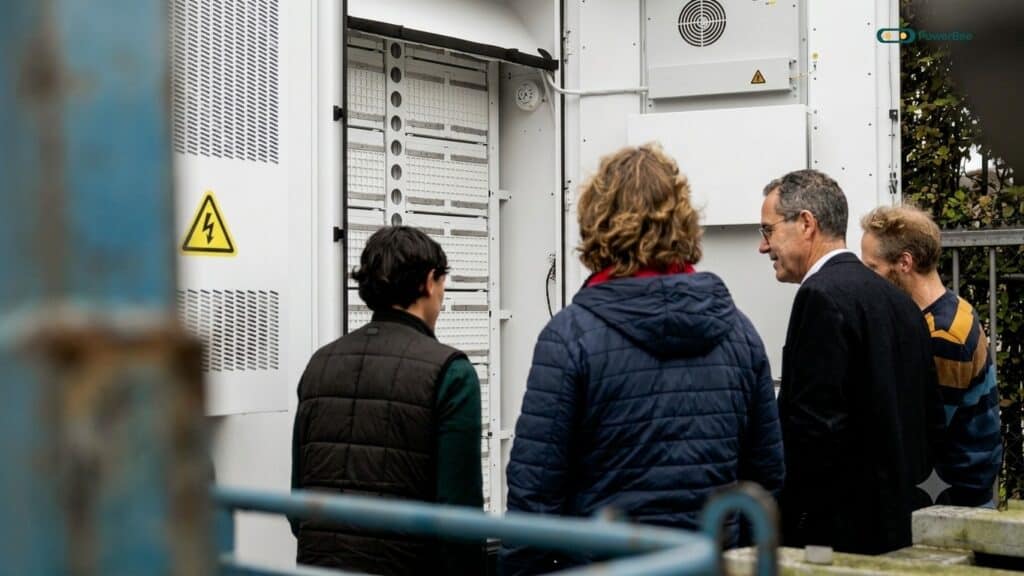
Battery Storage stands out prominently in this context, because the temporary storage of electrical energy is explicitly mentioned in the energy categories.
For small and medium-sized businesses, a battery can help them use more of their own solar power, smooth out peaks, manage dynamic rates more effectively, and create greater flexibility within an existing grid connection. This can make a significant difference, especially for businesses with charging stations, solar panels, or growing energy demands.
But a battery only truly delivers its full potential when it is controlled properly. Without smart control, some of that potential goes unused.
Where PowerBee Makes a Difference
PowerBee helps businesses make data-driven decisions about energy investments. We analyze your energy consumption, peak loads, and opportunities, and determine which solution will have the greatest impact: battery storage, smart control, charging management, solar panels, or a combination of these.
In this way, the investment tax credit becomes not just a separate, retroactive tax benefit, but part of a broader energy strategy.
Smart investing starts with numbers
The investment tax credit could make energy projects more attractive in 2026, especially for companies investing in battery storage, renewable energy, electrification, or charging infrastructure.
But the key question remains: Which investment will yield the greatest return for your business?
With an energy audit , PowerBee maps out your energy consumption, peaks, and opportunities. This helps you see where you’re losing money today, which solutions are technically feasible, and how you can make a more informed investment decision.
Because the best energy investment isn’t necessarily the biggest one. It’s the investment that fits your energy usage, your connection, and your future plans.
Request your energy scan today!